
Anna Newhoff
NCR Reporter
As the county expands with new businesses and commercial hubs, it’s easy to overlook the breathtaking natural beauty. While many residents of Nassau County flock to the beach for relaxation, the West Side offers a different kind of escape – three state forests filled with hiking trails, wildlife, and outdoor adventures for the whole family.
“It’s not just the beaches; Florida has so much more to offer,” said Forestry Recreation Coordinator Justin Rogers. He serves the Jacksonville District of the Florida Forest Service.
Four Creeks State Forest is located between Callahan and Yulee on approximately 13,658 acres. It’s named after the four waterways that wind through it: Alligator (Mills) Creek, Thomas Creek, Boggy Creek, and Plummer Creek. The waterways merge together to form the head of the Nassau River. White-tailed deer, wild turkey, gopher tortoises, and wild hogs are just some of the wildlife that call Four Creeks home.
The forest has two entrances. One is on Bismark Road in Callahan. The other entrance is off State Road 200 in Callahan. There are several boat landings throughout the forest, including Hobbs Landing, Saul’s Landing, and Boggy Creek Landing.
“Folks are able to fish right off the bank at all three of those areas, and launch kayaks and canoes,” said Rogers.
All three boat ramps are accessible by two-wheel drive vehicles, but flooding can cause access issues in some areas.
Visitors can enjoy a variety of recreational activities at Four Creeks, including hiking, camping, kayaking, horseback riding, hunting, and fishing. Fishing is permitted year-round, while hunting is allowed during designated seasons with the appropriate licenses, permits, and stamps.
For maps, hunting regulations, permit details, and information on area rules, visit the Florida Fish and Wildlife Conservation Commission’s website or call 904-758-0525.
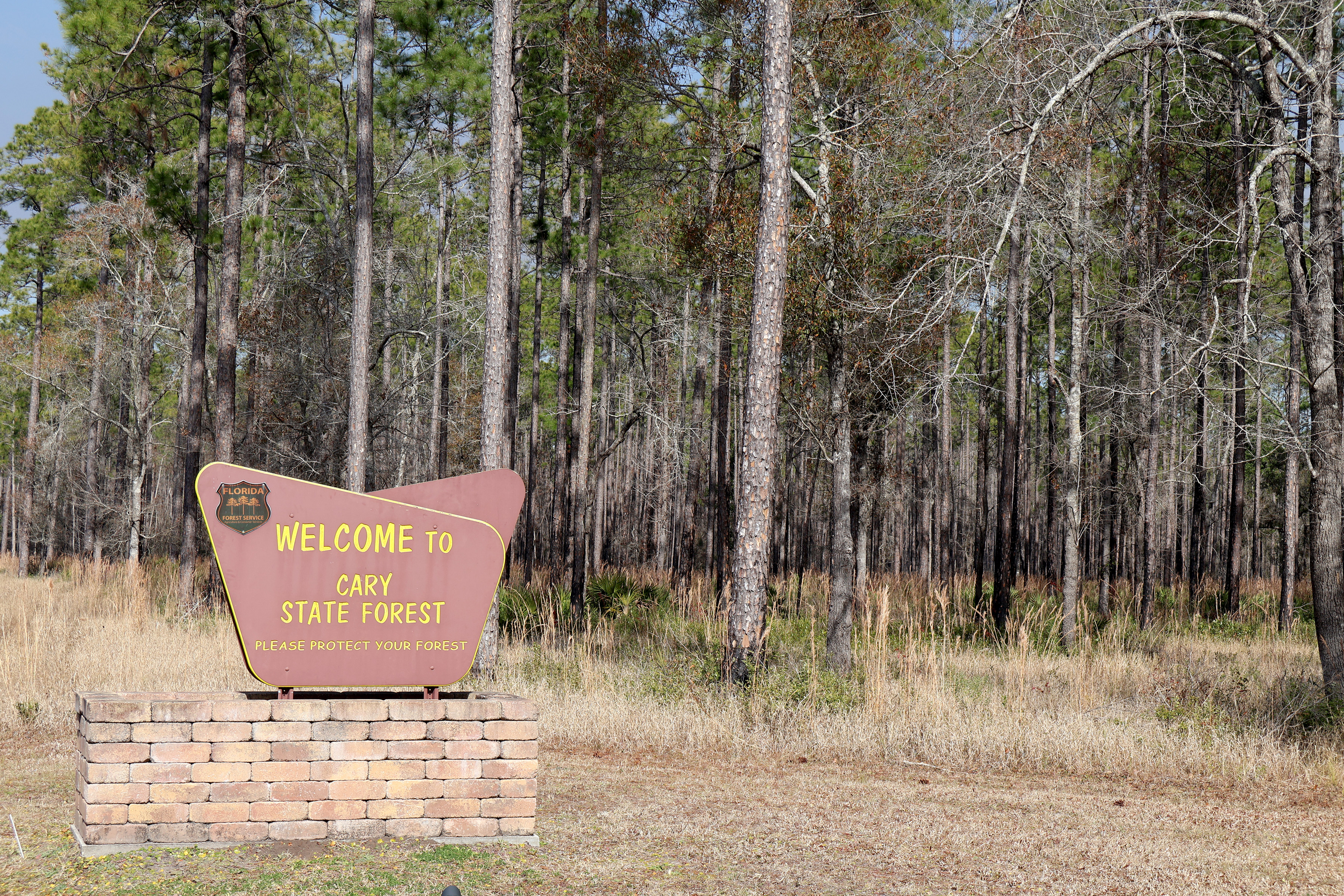
Established in 1937, Cary State Forest in Bryceville became Florida’s second state forest. It originally spanned more than 3,000 acres, but as more land was purchased, it now spans more than 13,000 acres of forest uplands and swamps. Before becoming state land, the forest was used for cattle farming and trees were used to farm turpentine.
The forest offers space for outdoor recreation, including seasonal hunting, wildlife viewing, horseback riding, camping, hiking, biking, and picnicking, allowing for guests to escape the stress of everyday life.
“You can really go out to the forest and be by yourself if you want to, so I think people get a lot of joy from that,” Rogers said
Visitors may spot a variety of wildlife, including white-tailed deer, wild turkey, bobcats, otters, alligators, great-horned and barred owls, wild hogs, and numerous bird species. The forest is also home to endangered species such as gopher tortoises, gopher frogs, Sherman’s fox squirrels, wood storks, and swallow-tailed kites.
To help maintain the ecosystem, controlled burns are conducted to support native plant and animal species while reducing the risk of wildfires.
When it comes to camping, both primitive and recreational vehicle campsites are available at the Cary Campground. Restrooms and shower facilities can be found a short hike from each campsite. Out of the three local state forests, Cary is the only one that offers RV camping spots for guests. Reservations can be made at reserveamerica.com or by calling 877-879-3859.
Visitors of all ages, including pets, can enjoy the forest year-round for a fee of $2 per adult, while children under 6 can enter for free.
The forest also features two designated horseback riding trails. The Fireline Trail, marked with yellow bands, is 12 miles long. The Red Root Trail, marked with red diamonds, is almost 8 miles long. Biking and hiking are also permitted on both trails. When on state land, horseback riders must have proof of current negative Coggins test results for their horses.
Located in Hilliard, Ralph E. Simmons State Forest offers guests the chance to soak in the St. Marys River. Originally named after the river, the forest was renamed in 1996 in memory of a former St. Johns River Water Management District Governing Board member who played a significant role in purchasing the forest in 1992.
The forest features the river and two oxbow lakes, U-shaped bodies of water formed when a wide river channel is cut off, creating the free-standing lake. Wildlife such as foxes, wild turkey, bobcats, gopher tortoises, and otters can be spotted throughout the forest.
Ralph E. Simmons State Forest offers guest a variety of scenery, which makes it a favorite of Rogers’.
“I just enjoy the topography that just rolls right down to the river,” he said.
The Florida Forest Service conducts controlled burns as part of a timber management practice used to restore and maintain the forest ecosystem while ensuring sustainable timber production.
Similar to the other state forests, Ralph E. Simmons offers hiking, horseback riding, off-road bicycling, camping, hunting, and fishing.
Primitive campsites are located along the St. Marys River and are available at a first-come, first-served basis during non-hunting seasons. Group camping is also available by State Forest Use Authorization, which can be obtained from the Florida Forest Service located at the Hilliard Work Center.
All state forests offer volunteer opportunities for maintaining recreational areas. For more information regarding volunteering, email Justin.Rogers@FDACS.gov or call 904-529-2353
These three state forests provide an abundance of opportunities for residents and visitors alike to explore and appreciate the natural beauty of Nassau County.
“It’s the public’s land,” said Rogers. “It’s theirs to enjoy.”